Showing posts with label Say No to the Mow. Show all posts

Wednesday, 30 July 2014

Say GO to the mow!

Dr Trevor Dines
Plantlife Botanical Specialist


I’m standing in a meadow in Sussex on the hottest day of the year. The July sun is doing a good job of bleaching the scene but, even this late in the season, the straw-brown field is punctuated with colour; deep purple betony (Stachys officinalis) with its short, fat flower spikes and tall Devils’-bit Scabious (Succisa pratensis) throwing blue discs above the grasses. At my feet, yellow Lady’s-bedstraw (Galium verum) is sprawled through the sward, reminiscent of its former use to sweeten the scent of straw-stuffed mattresses.

The sound is incredible too, the myriad of crickets, grasshoppers, hoverflies and bees reminiscent of a tropical rainforest. But walking through the meadow creates another sound too. The pods of Yellow-rattle (Rhinanthus minor - image right) are ripe – dry, swollen and fat with seeds that rattle under every footstep. Traditionally, Lammas Day, the 1st August, was the day to start cutting hay cut, the first harvest of the year. But farmers would instead often be guided by Yellow-rattle, the rattling a signal to farmers that the hay was ready to cut.

It can feel like an horrific act of brutality to cut down a meadow in its prime, but in fact it is the single most important point in the annual meadow cycle. It provides valuable fodder and bedding for livestock, it removes nutrients from the field, keeping soil fertility down and allowing more delicate flowers to thrive, and it keeps brambles, bracken, saplings and other thuggish plants in check. If it wasn’t for the hay cut, meadows would quickly revert to scrub and woodland, losing much of their colour and wildlife along the way.

All over the country, meadows are resonating not just with the sounds of wildlife but with tractors, mowers, hay turners and bailers. As well as providing a valuable farm income, this green hay is also being used to literally seed new meadows. The sites for these will have first been cleared and lightly cultivated, just enough to break up the soil surface. Green hay is then taken from a good, ancient, flower-rich meadow nearby and transported to the new fields where it is strewn and then either rolled or grazed by cattle. In this way, all the seed from the plants in the hay drops into the soil, ready to germinate with the first rains. The results can be spectacular, with apparently ancient meadows, full of the flowers characteristic of the local area becoming established in just two or three years. As part of the Coronation Meadows project, 12 such meadows were recreated in 2013, and over 120 hectares of restoration are planned this year.


Volunteers from local communities all over the UK are involved, helping out with both cutting and spreading green hay. Scything courses have become popular, this traditional form of mowing providing a tough work-out. In some cases, seed of special flowers, such as Melancholy Thistle (Cirsium heterophyllum) and Dyer’s Greenweed (Genista tinctoria), are being collected and grown to plant out in local meadows next year. Artists are capturing the action of the hay-cut, as well as the beauty of the meadows themselves, and sound-recorders are capturing that cacophony of meadow music that’s so much part of the meadow experience.

So, from now on it’s essential that we say GO to the mow! Not just in meadows, either:

  • If you’ve left a patch of grass unmown in your lawn, you can give it a good trim. Attack it with a strimmer or pair of shears, remove the growth and then mow the grass hard back. Treat it like a normal lawn until Christmas and then leave the same patch to grow back next year. Managed this way, the number of species and flowers is likely to increase.
  • Our flower-rich roadside verges are meadows too. As part of our Road Verge Campaign, we’re asking Local Councils to start mowing the entire width of their verges now and remove clippings where possible. If you see verges being cut for the first time now, they might have signed up to our Campaign. If not, or if they’ve been cut already, why not lend your signature to our petition?

Kicking my way through the meadow, another sound can be heard. A tractor pulls into the field with mower in tow. The farmer engages the machinery and sets to work, the tall grass reduced to strips of hay in an instant. It looks so destructive as the stunning meadow is turned to an apparently nondescript agricultural field. But this hay will soon be taken from here and put to good use. I pick some up and give it a shake. My palm and fingers are showered with the precious seed, yellow-rattle in particular. I hold a new meadow in my hand.

Tuesday, 10 June 2014

What happened when I said "No to the Mow"...

Dr Trevor Dines
Plantlife Botanical Specialist


It was not a good start. I marked out a patch of lawn in early March, selecting an area that wasn’t particularly special but did at least have a few cowslips. I could see their rounded leaves poking through the turf and thought it’d be nice to spare them the mower and allow them to flower.

But a few weeks later they had gone – completely vanished – and the grass didn’t seem to have grown much either. I couldn’t work it out. Then, returning from work one day I found the culprits; three sheep had found their way through the fence and were having a very merry time munching away on the lawn. I’m amazed they were so selective, but they’d found each cowslip plant and eaten them right down to the roots.

My new campaign, “say no to the sheep”, started with a patch they’d thankfully not reached. The mower came out of hibernation in a grumbling, spluttering mood and over the next few weeks the patch began to take on its shape and texture as the grass grew. Now, I’ll be the first to admit that my lawn won’t win any prizes in the next series of “The Great British Lawn Off” or “Come Mow With Me”; it’s not seen any herbicides or fertilizers in the 18 years I’ve looked after it so it’s pretty full of things other than grass. But this doesn’t mean they get to flower. Most of the lawn is kept pretty tightly mown so it’s rare that anything taller than a daisy gets to raise its head above the blades.


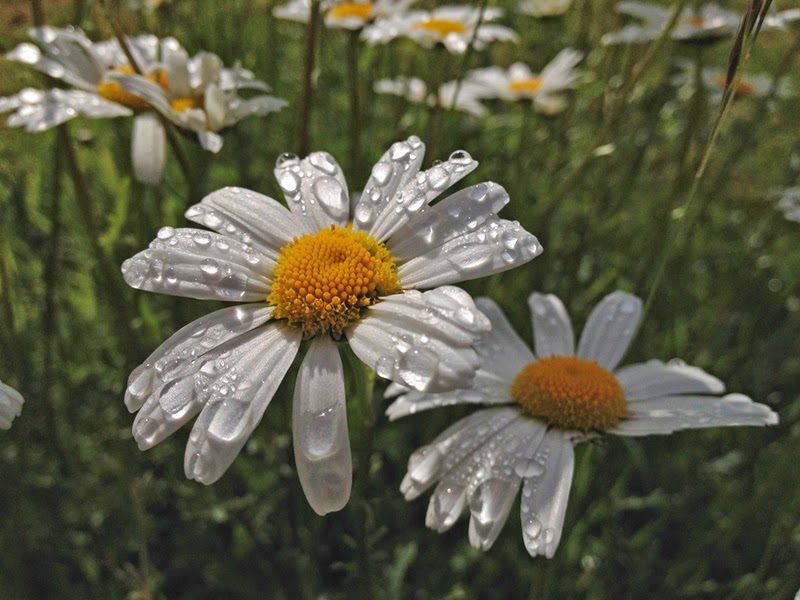
It has therefore, frankly, been a joy therefore to see what has come up. While not a mad riot of wild flowers, the procession of species has been fascinating to watch over the last few weeks, starting with cuckoo flower, dandelions and thyme-leaved speedwell, moving on to creeping buttercup and a few glorious oxeye daisies at the moment, and with self heal and clovers to come. It’s been a delight to actually pause and look in detail at a small patch of grass, noticing that this is where the pheasants now like to linger and where banded snails are most frequent.

The grasses are also playing their part of course, with tiny spreading meadow-grass now dwarfed by Yorkshire fog with its soft, downy leaves and purple haze. Common sorrel is also there, looking rusted-red and hinting at the poor nature of the soil. In total, I’ve found eighteen species in a 2m x 2m square, not a spectacular haul but far better than your average rye-grass and bent-grass dominated lawn. It’s not a diversity of species that I’m looking for (although this will come in time) but giving an opportunity for plants to flower, provide nectar and pollen, set seed, be eaten by caterpillars and froghoppers and maybe even give a home to a grasshopper or two.

In a way, my patch of unmown lawn is like a little window on a real wildflower meadow or roadside verge. Around it, my lawn is green but bereft of any colour, just like many of the improved fields around our relict wildflower meadows and beside our verges. Many of the plants are still there: if we just give them a chance to grow and flower they grasp the opportunity and work wonders for our wildlife.


Thursday, 27 March 2014

Setting Up a No-Mow Zone.

Luke Morton
Plantlife Moderator


"Never ask of others what you are not willing to do yourself" said Eleanor Roosevelt and with that advice in mind, I have decided to take Plantlife's Say No to the Mow challenge by making a No-Mow Zone in my own back garden.

For those who have not heard of it, Say No to the Mow is a bit like a botanical Movember: both involve allowing a hirsute patch to flourish where normally you'd keep it cropped short. But instead of the hair on your upper lip, Plantlife is asking you to spare a small "No-Mow Zone" of lawn from your mower's blades this summer. Then as it begins to flourish, you can download a free ID sheet featuring fourteen key wild flowers and enter which ones you spot online. The results will form a blooming great map of the UK, showing what’s in flower and when.

But first things first: Where should I put my No-Mow Zone? Plantlife botanist (and passionate gardener) Dr Trevor Dines suggested choosing a spot away from the beds.


The grass here has not been mowed since last autumn. As a rule of thumb, the longer its been since you last mowed your patch the more likely you'll get wildflowers. March is a key cut-off month as plants are beginning to sprout for the spring, so any mowing that occurs later could stop some in their tracks.

Now I need to mark it out. Here's what I'll need:


There's no limit to the size or shape of your No-Mow Zone. You could make it the entire lawn or spell out your name. We say the ideal size for a No-Mow Zone is 2m squared, but as I've only a small garden I'm opting for 1m x 1m. Using the tape measure I place a peg at each corner:


With the pegs in place I then apply some string to keep that hungry mower at bay...


A finishing touch: my No-Mow Zone security guard. Would you mess with a gnome like this?


And there it is! Ready to flourish.


Next stop downloading my free ID sheet and adding what pops up to the online map which of the wildflowers pop up.

Joining me and my gnome in Saying No to Mow? We'd love to hear how you're getting on. Share your stories, sightings and photos with us on Twitter adding #saynomow.