Showing posts with label gardening. Show all posts

Tuesday, 10 June 2014

What happened when I said "No to the Mow"...

Dr Trevor Dines
Plantlife Botanical Specialist


It was not a good start. I marked out a patch of lawn in early March, selecting an area that wasn’t particularly special but did at least have a few cowslips. I could see their rounded leaves poking through the turf and thought it’d be nice to spare them the mower and allow them to flower.

But a few weeks later they had gone – completely vanished – and the grass didn’t seem to have grown much either. I couldn’t work it out. Then, returning from work one day I found the culprits; three sheep had found their way through the fence and were having a very merry time munching away on the lawn. I’m amazed they were so selective, but they’d found each cowslip plant and eaten them right down to the roots.

My new campaign, “say no to the sheep”, started with a patch they’d thankfully not reached. The mower came out of hibernation in a grumbling, spluttering mood and over the next few weeks the patch began to take on its shape and texture as the grass grew. Now, I’ll be the first to admit that my lawn won’t win any prizes in the next series of “The Great British Lawn Off” or “Come Mow With Me”; it’s not seen any herbicides or fertilizers in the 18 years I’ve looked after it so it’s pretty full of things other than grass. But this doesn’t mean they get to flower. Most of the lawn is kept pretty tightly mown so it’s rare that anything taller than a daisy gets to raise its head above the blades.


It has therefore, frankly, been a joy therefore to see what has come up. While not a mad riot of wild flowers, the procession of species has been fascinating to watch over the last few weeks, starting with cuckoo flower, dandelions and thyme-leaved speedwell, moving on to creeping buttercup and a few glorious oxeye daisies at the moment, and with self heal and clovers to come. It’s been a delight to actually pause and look in detail at a small patch of grass, noticing that this is where the pheasants now like to linger and where banded snails are most frequent.
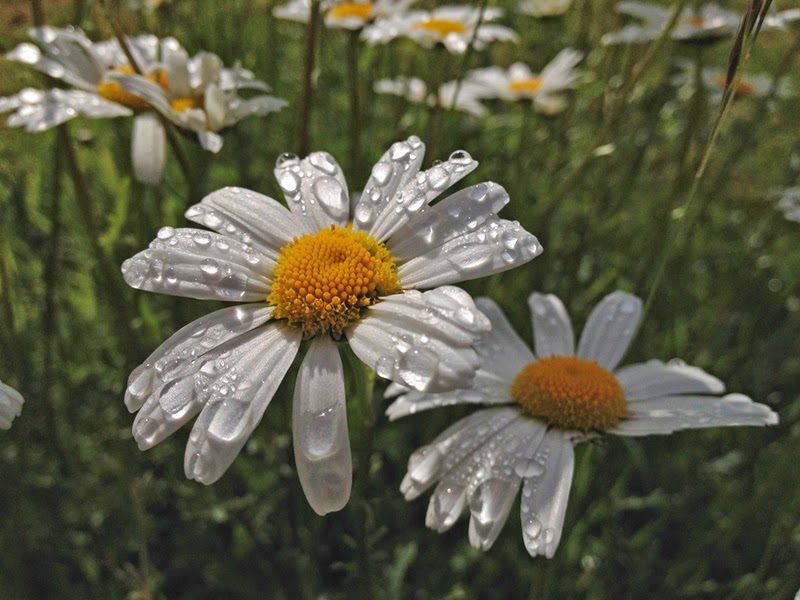
The grasses are also playing their part of course, with tiny spreading meadow-grass now dwarfed by Yorkshire fog with its soft, downy leaves and purple haze. Common sorrel is also there, looking rusted-red and hinting at the poor nature of the soil. In total, I’ve found eighteen species in a 2m x 2m square, not a spectacular haul but far better than your average rye-grass and bent-grass dominated lawn. It’s not a diversity of species that I’m looking for (although this will come in time) but giving an opportunity for plants to flower, provide nectar and pollen, set seed, be eaten by caterpillars and froghoppers and maybe even give a home to a grasshopper or two.

In a way, my patch of unmown lawn is like a little window on a real wildflower meadow or roadside verge. Around it, my lawn is green but bereft of any colour, just like many of the improved fields around our relict wildflower meadows and beside our verges. Many of the plants are still there: if we just give them a chance to grow and flower they grasp the opportunity and work wonders for our wildlife.


Wednesday, 21 May 2014

Showtime for Wildflowers

Dr Trevor Dines
Plantlife Botanical Specialist


I was a botanist on a mission: find as many native plants as possible. With show gardens, a massive Floral Marquee and loads of nurseries, the RHS Malvern Spring Festival appeals to both the ordinary gardener and the plantaholic. It’s a good way of seeing what, horticulturally, is in vogue each year and I was there to discover how our native flora fares against the rest of the world.

A few years ago, there was a trend for native plants in “wildlife” gardens. Designers were using them as statements in their gardens, a way of challenging the norm. These days, our native flora is finding more of a natural home in the designs, being woven through the tapestry of the garden rather than a tick-box “this is our wildflower bit”.

So, winner of “Best Festival Garden” was an exquisite little formal garden by designers Ana Mari Bull and Lorenzo Volpini of LSV Gardens & Associates. Striking cloud-clipped hornbeam bushes lined a central path flanked by geometric blocks of planting, with native box alternating with softer ragged-robin, white wood crane’s-bill and tufted hair-grass. Mixed in with these were non-natives including dame’s-violet and snowy woodrush. I loved the way natives species featured strongly, but as an integral part of the design and not as a gimmick.

Ragged-robin (pictured left) was actually a bit of a star of the whole show. In the floral marquee, I found it featured it many nursery displays, the wild pink form sitting alongside the sublime white variety ‘White Robin’ and the double ‘Jenny’ (this one rather garish to my eyes, but fine if you like bright pink pom-poms). White was a theme too; Hardy’s Cottage Plants paired frothy woodruff with a white herb Robert under a canopy of solomon's-seal with its hanging ivory bells (pictured below right).

Not surprisingly, the fern nurseries drew heavily on our native fern heritage. In Fibrex Nursery’s bold display, it was good to see magnificent native royal ferns holding their own alongside tropical tree ferns. Beneath them grew a plethora of varieties of male fern, soft shield fern and lady fern, the latter including ‘frizelliae’ with its bizarre, tiny, alternating fronds.

I was particularly pleased to see the Alpine Garden Society display, one of their competitive events in which members growing skills are put to the test. Among the various categories I spotted dwarf birch ‘Glengarry’, several stunning pots of Dickie’s bladder fern (which originates from a single cave in Aberdeenshire) and, my personal highlight, a large clump of lady’s slipper orchid with a dozen pristine blooms.

For me, the show encapsulated the many ways in which gardeners engage with native plants. I loved the common alongside the rare, the formal alongside the informal, and the perfect alongside the imperfect. All were welcome and all had a part to play alongside plants from around the world.


We had a plant of bastard balm on the Plantlife stand at the show. It really drew an audience, its flowers looking like rude faces with pink tongues sticking out. Those that knew it were often surprised to learn it’s a rare native species and of our work to conserve it. This is the aim of The Wildflower Garden, to celebrate our native flora and make connections between gardens and wild flowers. Many of them are rather wonderful garden plants.


Friday, 2 May 2014

The Wildflower Garden

Dr Trevor Dines
Plantlife Botanical Specialist


Did you know that many of our garden favourites, like box (Buxus sempervirens) and Welsh poppy (Meconopsis cambrica) are also some of our rarest native plants?

It always amazes me that you can pop into almost any garden centre, DIY shop or nursery in the country and buy a plant of shrubby cinquefoil (Potentilla fruticosa), but this same species is a beautiful native wildflower restricted to just two small areas of Britain.

It was partly because of this that we decided to launch Plantlife’s Wildflower Garden. It aims to celebrate the rare and common native flowers we probably already grow, introduce you to a few new ones and also uncover the fascinating stories behind them (according to legend, for example, Pasqueflower (Pulsatilla vulgaris) grows from the blood of buried Viking warriors!) We want to celebrate our wild flowers and help you make the most of growing them in your own garden.

We’ll also help you select wild flowers suitable for your own garden and give advice on how best to grow them. You don’t need to let your garden become overgrown and tatty to enjoy wild flowers, they can be woven into the tapestry of all garden styles, from informal cottage to clipped and formal.

The subject is one close to my heart. As well as being Botanical Specialist at Plantlife, I’m also a passionate gardener. I inherited the gardening bug from my grandparents; one of my clearest childhood memories is of my grandmother discovering wild fritillaries (Fritillaria meleagris) in water meadows on the farm where I grew up. Back in her own garden she showed me the same flowers she’d planted in the lawn and the connection between garden and the wild has fascinated me ever since.

Watch out for regular updates as we go through the gardening year. We’ll be adding more plant profiles to the list and features with ideas and suggestions on how to make the most of wild flowers in your garden throughout the year.

So what are you waiting for? Why not sit back with a cup of tea and explore our native garden flora…

Tuesday, 1 April 2014

Taking Action on Invasive Plants

Nicola Hutchinson
Head of Conservation, England and Wales


Just over a year ago I vented my frustration on this blog about the news that a long needed ban on the sale some of the most invasive non-native water plants had been announced and then immediately delayed for 14 months to allow for retailers 'to adjust'.  Fortunately we have finally reached the day when it really is against the law for floating pennywort, water primrose, New Zealand pigmyweed, parrot’s-feather and water fern to be sold in England and Wales.  Good, that's one thing out of the way.  But what else do we need to crack on with to really make a difference with this well documented environmental problem?

Over the past year the political arena for invasive non-native species has actually been quite a busy one, headlined by negotiations on an EU-wide regulation which is inching towards conclusion.  This regulation would set rules to help all Member States prevent and manage invasions, and it makes sense to do so at this scale.  Rarely does the natural environment respect political or administrative boundaries, but perhaps more importantly in this case are the trade rules that operate on an EU scale.  Hopefully one result of the regulation will be the total prevention of new potentially invasive species into the whole of the EU, and what is called 'regional cooperation' to tackle species causing particular problems in any one country.  So, first on the jobs list is one for the European Parliament to ensure it votes this regulation through.

The next step we should take is back on domestic shores, that's doing something with the review of the GB Strategy on Non-Native Invasives which has also taken place this past year.  Admittedly the strategy bit sounds a tad dull but if you cut to the chase then what this piece of national policy can give us is the opportunity to prioritise and work together on our biggest problem areas.  This might mean increasing our look out for new invasives in known trouble spots, or targeting resources to whole landscapes and catchments to truly rid them of established invasives.  There is a lot of activity already going on out there in our towns and countryside to get on top of species invasions, we simply could make a greater impact with some proper national support.  This one sits in Defra's camp for now, yet as ever we are ready to help where we can.

My final choice of where we need to go next with invasives is a challenge outside of government, one aimed at how we view the scale of the problem posed by non-native invasives.  We were recently asked by a journalist to comment on a story which headlined that gardeners who grow rhododendrons were to be criminalised by the new regulations coming through.  What we offered in response was a sense of perspective.  It is indeed true that a particular species of rhododendron (Rhododendron ponticum x Rhododendron maximum)  has escaped into the wild and causing major problems in areas such as Snowdonia and the wonderful Atlantic woodlands of Scotland's West Coast.  However, there are plenty of other varieties of rhododendron which grow merrily in parks and gardens without causing any damage; the same can be said for most invasive non-natives, where there is a bad guy there will be plenty of good alternatives.  We are always careful to point this out and what I'm seeking here is to urge everyone not to cause unnecessary concern through oversimplification or exaggeration.  Addressing invasive species is not a blame game, rather it is an action game: there is a problem and we have spent a lot of time working out precisely which species and issues we need to be concerned with. So let's focus our efforts, get on with the tasks at hand, and collectively make the difference we can.


Wednesday, 19 February 2014

Two Native Stars of the Winter Garden

Posted by Dr Trevor Dines

During the long, dark days of winter, we make many demands on our gardens, craving colour, form and texture. Two stalwarts that rise to the challenge admirably are box and dogwood, providing evergreen structure and coloured stems respectively. Yet both are also native to Britain, one being common, one rare.

The common one is dogwood Cornus sanguinea, a familiar plant along hedgerows and in woodland and scrub on lime-rich soils. It grows with such frequency that it’s often taken for granted, but take a second glance and you’ll see it’s a handsome shrub, with broad, deeply corrugated leaves and umbels of white flowers, followed in autumn by black berries.

These are all set off by its young shoots; lustrous, dark red stems that give the plant the scientific name, sanguinea, from the Latin meaning blood-red. As a final performance at the end of the autumn, the leaves turn fiery reds and butter yellows before falling, allowing the bare shoots to glow vibrantly in the winter sunshine.

Mature plants yield a dense, strong and flexible wood; this was once used to manufacture whippletrees (a cross-bar used to tether a horse to a cart or plough). This was another name for the plant. The wood was also used for making ‘dags’ (skewers and daggers) and called ‘dagwood’ as a result, which over time became dogwood, although other histories tell that the bark was used as a mange treatment for dogs, hence ‘dogwood’.

Box Buxus sempervirens needs little description – the familiar clipped, sculptured and topiaried evergreen so prominent in countless gardens. Given its popularity, it might come as a surprise that it’s one of our rarest native plants.

Although widely naturalised and planted in woodlands throughout England and Wales, it is believed to be truly native at just two chalk downland sites. Not surprisingly their names bear witness to the presence of the plant - Box Hill in Surrey and Boxley in Kent.

In the wild and unconstrained by man, box grows into luxuriant trees with wonderful twisted trunks and branches. Most plants grow in open woodland along with yew Taxus baccata and are home to the equally rare Box Hill bug. Like dogwood, box gives a very fine-grained, beautiful wood that is still in demand for making a variety of things from rolling pins to chess pieces and wind instruments.


Tuesday, 29 January 2013

Five invasive non-native aquatic plants banned from sale: our response.


Posted by Nicola Hutchinson, our Head of Conservation Programmes, England and Wales.

The problem of invasive non-native species (sometimes called alien species) is one of the best known environmental issues. Whether in towns or countryside many of us will have dealt with garden ponds or rivers choked with water weeds, watched Japanese knotweed grow and spread wherever it has taken root, and perhaps even admired the pink flowers of Himalayan balsam along a riverbank before thinking how much it has taken over.  Internationally, invasive species have long been recognised as one of the top threats to wildlife and the environment.  Ten years ago our own government set out a series of recommendations to deal with the problem and currently the European Union is considering a Directive as a way to better coordinate a response.  It's important stuff.

This is why it's great to hear the Government announce today that five of the most destructive invasive water plants will no longer be legally traded in England and Wales.  At last, some decisive and essential action.

Australian stonecrop, Crassula helmsii
one of the banned plants © GBNNSS
A range of specific measures are needed to really crack the problem,  with the most important of these being to curb the number of new incidences.  The primary mechanism for which is to simply ban the most troublesome from sale.  No matter how conscientious we as gardeners or landscapers may be, once invasive species are established in our gardens and parks they find their way over the fence into our streets and countryside.  Don't put them there in the first place and we've instantly removed a key pathway for invasion.

However, herein lies the twist with today's news.  The industry which trades in these problem species in England and Wales has been given a further 14 months to "adjust" to the new regulation.  This means that trading can continue until April 2014 - a move to allow existing stock and pre-orders of these invasive water weeds to be sold off.  Really, it beggars belief.  It's been agreed that these species are so damaging to our environment that it must become illegal for them to be sold, yet here we are inviting the biggest of all 'every last item must go' sale.  Are we really saying we want one last final push to get as many of these water weeds out of the shops and into the wild?

This sort of compromise agreement is one of the most frustrating aspects of environmental politics.  We are falling over evidence on the impacts of invasives; ten years ago the government recommended a ban on sale of the worst offenders, and 7 years ago the actual legislation was put in place to enable this to happen.  Yet, at the last minute, we've lost our nerve, ending up with a really smart move turning into a ridiculous one.

Government moved to halt the trade in ash trees, harbouring a non-native fungal invader, in response to the ash dieback crisis.  Questions were asked at the time whether this action was taken quick enough.  It seems we aren't learning our lessons well.

A sheep struggles through a channel choked with
Floating Pennywort © Trevor Renals
In these economic times, one appreciates the difficulties businesses may face when new regulations mean changes to the way they operate. However, in the case of invasive non-native plants, representatives of the horticultural and aquatic trades have been involved in discussions for well over a decade. Couple that with the legislation being put in place in 2006, the list of proposed species to ban consulted on in 2010, and this stacks up to ample time for traders and retailers to adjust already.  No-one in the industry can say they didn't know this was coming.


It makes me mad.  So I have to remind myself at these times that amidst the ditherings of others, here at Plantlife we've just been getting on with doing our best to implement solutions. Often that has meant direct action on the ground to clear established invaders from some of our most important places for wildflowers such as the Isle of Portland and the limestone cliffs of Torbay. And, with the principle of prevention being better than cure at the forefront of our efforts, we have researched which of the thousands of water and land plants available for sale pose the greatest threat to our native wildlife- this helps to hone our collective response, and gives the green light to the overwhelming majority of garden and pond plants available.   Indeed, to make it even easier for retailers and consumers we've worked with partners to publish reports and advice on which plants to choose as alternatives to those which cause problems (see our guides to landscaping and keeping ponds and aquaria without harmful invasive plants).

We've invested our time and resources into working out solutions to the invasive species problem because it really matters when it comes to conserving wild plants, incredible landscapes and other wildlife. Now we need everyone's help - do the right thing, it's easy, stop selling and stop buying these plants:


And whilst you're at it, avoid these other ones too because they're equally as bad…

In the meantime, Plantlife applauds those retailers who've already made the shift to stop selling invasive plants, or who at least avoid the temptation to offer a 'buy one get one free' on curly waterweed!

For everything else you need to know about avoiding invasive plants and suggestions for fabulously non-invasive plants to grow have a look here.